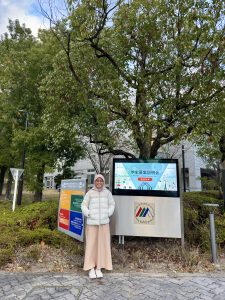
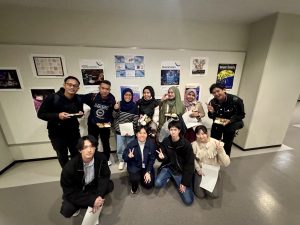
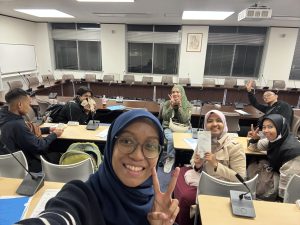
The Materials Science Pre-screening Internship Program 2025, organized by the Nara Institute of Science and Technology (NAIST), once again offered students from various countries the opportunity to gain hands-on research experience in an international-standard laboratory environment. This year, two representatives from the Department of Physics, Universitas Gadjah Mada (UGM)—Larrisa Jestha Mahardhika and Husna Ajrina—successfully passed the selection process and participated in the onsite internship held in Nara, Japan, from 24 November to 6 December 2025. Larrisa has completed her master’s degree, while Husna is an active fourth-semester student in the Master’s Program in Physics.
In addition to serving as a platform for deepening research experience, the program also functions as part of the pre-screening process for obtaining recommendations to pursue doctoral studies at NAIST. As such, the internship represents a strategic opportunity for participants to demonstrate their research capabilities while building academic networks with NAIST professors. A total of 12 students from four countries—Indonesia, Malaysia, China, and the Philippines—were selected this year. The selection process began with an internal assessment at NAIST partner universities; at UGM, this stage was conducted by the Faculty of Mathematics and Natural Sciences before the candidates’ applications were forwarded and further evaluated by NAIST. All expenses, including accommodation and access to laboratory facilities, were fully funded by NAIST.
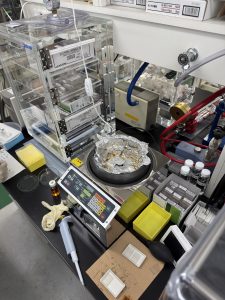
Larrisa and Husna undertook research rotations in three laboratories under the Division of Materials Science, aligned with their respective research interests. During the program, Larrisa conducted activities in the Materials Informatics Laboratory, the Quantum Photo-Science Laboratory, and the Bio-Process Engineering Laboratory. She studied Python programming for machine learning modeling, observed photocatalytic experiments, learned fundamental concepts of polaritons through vibrational strong coupling phenomena and performed data analysis using the Julia programming language, and explored microfluidic systems, including microfluidic chip measurements and droplet generation experiments. Meanwhile, Husna rotated through the Materials Informatics Laboratory, the Quantum Photo-Science Laboratory, and the Solid-State Information Physics Laboratory, where she was introduced to surface science concepts, photoelectron holography, and photoelectron spectroscopy systems developed by the research group.
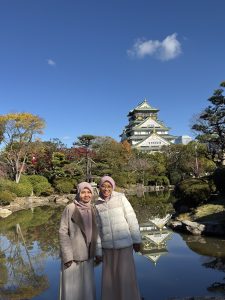
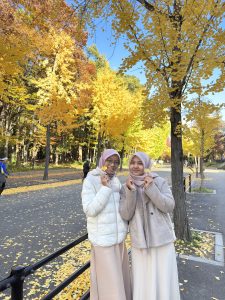
Outside academic activities on weekdays, participants took advantage of the weekends to explore Japanese culture, history, and the local atmosphere. Larrisa and Husna visited Osaka Castle and Nara Park—two iconic destinations that allowed them to experience Japan’s historical ambiance, traditional architecture, and direct interaction with the deer that symbolize the city of Nara.
Reflecting on her experience, Larrisa stated that the program provided valuable insights into modern research approaches and broadened her perspective on opportunities for pursuing doctoral studies abroad. “Through this internship program, I gained highly valuable research experience. During my time at NAIST, I was able to directly observe how modern research is conducted through multidisciplinary collaboration, the use of advanced technological instruments, and an academic culture that is very open to discussion. The opportunity to engage directly with international researchers and professors has broadened my perspective, particularly in developing potential doctoral research topics,” she said.
Husna expressed a similar appreciation, emphasizing that hands-on learning in the laboratory expanded her perspective on collaborative research and cutting-edge technology. “The opportunity to observe experiments, engage in direct discussions with international researchers, and witness firsthand the work ethic, research culture, and disciplined academic environment at NAIST has been an extremely valuable experience and has provided strong motivation for me to continue improving my competencies,” she remarked.
Both participants hope that similar opportunities will continue to be made available to Indonesian students, particularly those from UGM, in order to strengthen research networks and enhance academic competitiveness at the global level.